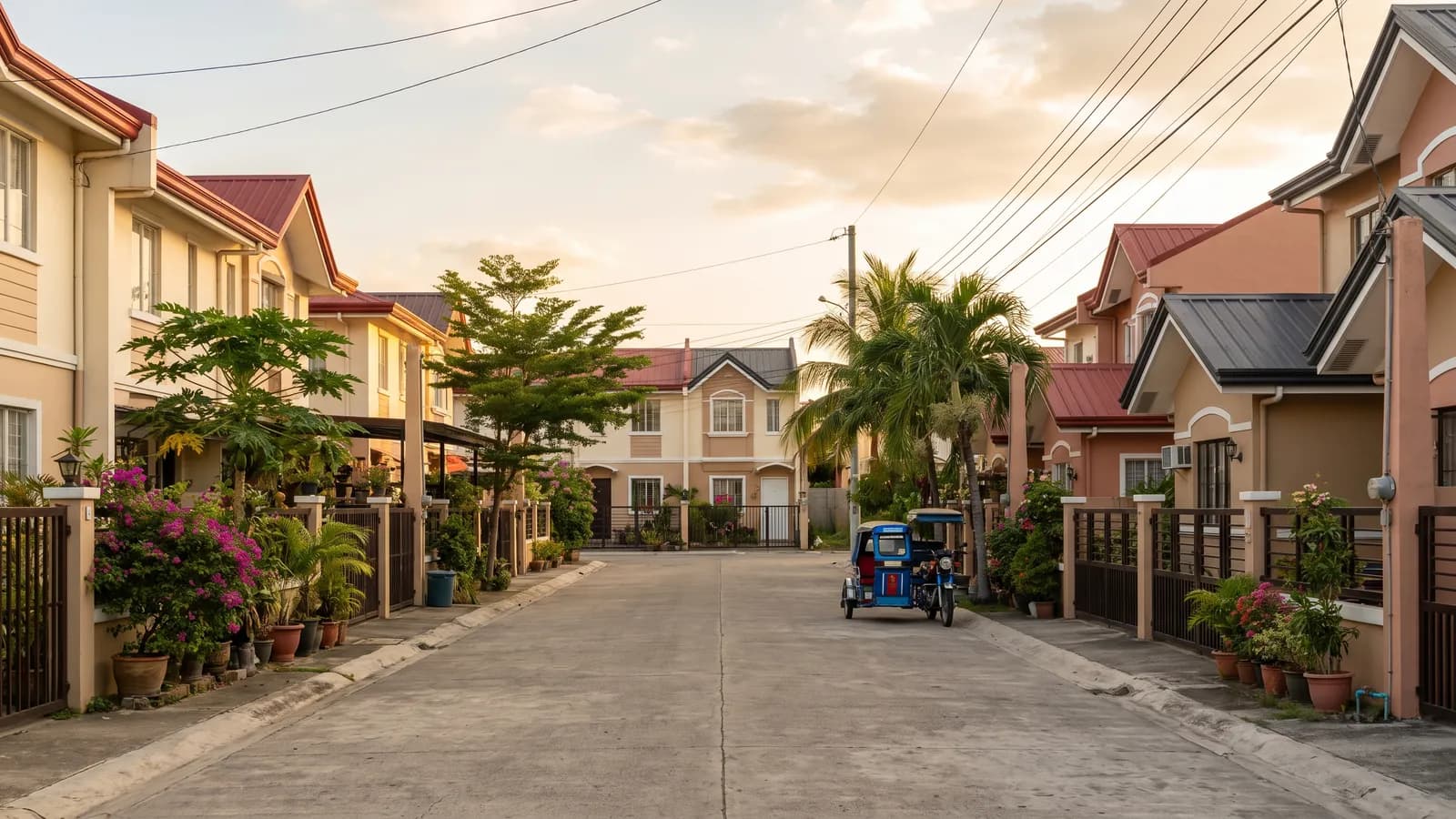
Pag-IBIG foreclosed properties are homes that were financed with a Pag-IBIG housing loan, taken back by the Fund after the borrower defaulted, and then resold to the public. Pag-IBIG's official name for them is Acquired Assets. They are sold through the Pag-IBIG Online Public Auction in three stages: a first public auction with no discount, a second public auction with discounts of up to 30%, and a negotiated sale with discounts of up to 45%. This guide explains each stage, who can buy, how to bid online and how to pay.
Prefer to shop first? Browse the live Pag-IBIG acquired assets database (6,062 properties as of October 11, 2026, refreshed daily). Portal details in this guide were checked on the official Pag-IBIG Fund Online Public Auction portal in October 2026.
Updated October 2026. The promo loan rates below apply to applications filed until December 31, 2026. If you are reading this in 2027, check Pag-IBIG's current rates first.
What Are Pag-IBIG Foreclosed Properties (Acquired Assets)?
Most Acquired Assets started out as someone else's home loan. When a borrower stops paying, Pag-IBIG forecloses, takes over the property and offers it for sale to recover the loan. The result is a steady, nationwide supply of pre-owned townhouses, house and lots, condo units and vacant lots, sold in rounds, with discounts in the later rounds.
Live snapshot, as of October 11, 2026:
- 6,062 active Pag-IBIG acquired assets across 50 provinces
- 1,454 in the first public auction, 802 in the second public auction and 3,806 in negotiated sale
- Median minimum price of ₱1,146,500; lowest ₱123,005; highest ₱9,438,357
- 2,582 properties at or under ₱1 million, and 4,910 at or under ₱2 million
Source: Pag-IBIG Fund Online Public Auction portal, synced to the sabahay.ph database daily.
Why Pag-IBIG calls them Acquired Assets
Pag-IBIG's charter, Republic Act 9679 of 2009, gives the Fund the power to acquire and dispose of real property (Section 13(e)). That is why the portal and official notices say Acquired Assets, while most buyers search for "foreclosed properties". Same homes, two names.
What "as is, where is" really means
- Condition. You accept the property in its current physical state, defects included, so inspect it before you bid.
- Occupancy. You also accept whoever is living there. Listings carry a status such as Occupied, Occupied/Closed, Unoccupied or Unoccupied-Lot.
Pag-IBIG also says it has no accredited brokers or agents for Acquired Assets. More on that in the scams section below.
1st Public Auction vs 2nd Public Auction vs Negotiated Sale
Pag-IBIG's FAQ says only that discounts apply in the second and third rounds of bidding. Its List of Winning Bids and Offers page is more specific, labeling the three tiers No Discount, Up to 30% Discount and Up to 45% Discount. Live counts below are as of October 11, 2026.
| Stage | Discount tier (portal label) | What drives the discount | Live listings | Share occupied | Browse |
|---|---|---|---|---|---|
| First public auction (new listings) | No discount | None; bid at least the minimum bid price | 1,454 | 82.5% | Current first public auction properties |
| Second public auction | Up to 30% | Mode of payment | 802 | 64.3% | Second public auction properties with bigger discounts |
| Negotiated sale | Up to 45% | Mode of payment and mode of sale | 3,806 | 64.8% | Pag-IBIG negotiated sale properties |
First public auction: no discount
A property enters as a New Listing in the First Auction tab. There is no discount: you bid at least the published minimum bid price and get first pick of the newest stock. This stage also has the highest occupied share in our data (82.5%), so check occupancy before you bid.
Second public auction: up to 30% discount
Properties that do not sell in the first round go to the Second Auction tab, which the portal labels "Up to 30% Discount". The discount depends on the winning bidder's mode of payment. The pool is smaller (802 listings) and the occupied share drops to 64.3%.
Negotiated sale: up to 45% discount
Properties still unsold after the public auctions move to Negotiated Sale, tagged "Up to 45% Discount", where the discount depends on both mode of payment and mode of sale. This is by far the largest pool (3,806 of 6,062 live listings), so budget-first buyers should start here. Rounds run continuously: the portal's winners page shows NCR Housing Hub bid openings for all three stages between October 5 and 7, 2026.
How payment mode changes the discount
Pag-IBIG publishes the ceilings but, on the pages we checked, no fixed table of discount by payment mode. Confirm the discount for the mode you will actually use (start with the portal's Acquired Asset Special Discount section) and compare net prices, not headline ceilings.
Who Can Buy Pag-IBIG Acquired Assets, and What You Need Before You Bid
The Online Public Auction is open to Pag-IBIG members and non-members, but the portal's FAQ lists the conditions below for individual buyers. It does not say which payment modes each one covers, so cash buyers should confirm with Pag-IBIG.
Pag-IBIG's published buyer requirements
- At least 24 monthly Pag-IBIG savings (paying the missing months in a lump sum is allowed)
- Age 65 or younger at loan application, and no older than 70 at loan maturity
- Legal capacity to buy and mortgage real property
- Pass Pag-IBIG's background, credit and employment or business checks
- No Pag-IBIG Short-Term Loan in arrears
- No previous Pag-IBIG housing loan that was foreclosed, cancelled, bought back due to default or settled through dacion en pago
- If you already hold a Pag-IBIG housing loan as borrower, co-borrower or co-buyer, that account must be up to date
Buyer ID checklist (IDs, selfie, mobile number)
Nobody bids without a Buyer ID, which you create on the portal. Registration asks for:
- One valid ID bearing your signature, uploaded as PNG, JPG, JPEG or PDF, maximum 3MB
- A clear selfie of you holding that same ID (group photos, photos with pets and blurry shots are rejected)
- An active Philippine mobile number that can receive a one-time PIN (OTP)
- A valid email address
- For companies and other juridical bidders only: a Secretary's Certificate
Barangay IDs or certifications, and company IDs from private employers, are not accepted for housing transactions. Pag-IBIG describes the Buyer ID as unique and non-transferable, so you cannot bid under a relative's ID or lend yours.
Companies, former owners and OFWs
- Organizations buying more than one property need accreditation under the Pag-IBIG Fund Employer Accreditation Program, an existing or planned Collection Servicing Agreement, and total purchases of at least ₱10 million.
- Former owners may bid on their old property, but only for cash (within 30 days) or short-term installment (within 12 months), not long-term installment.
- OFWs can register, get a Buyer ID and bid online from anywhere. A Virtual Pag-IBIG account is not required but is recommended; keep a Philippine SIM active for the OTP.
How to Buy Through the Pag-IBIG Online Public Auction, Step by Step
Since January 5, 2025, all bids for the first and second public auctions must be submitted through the Online Public Auction platform. Since May 13, 2025, the same applies to negotiated sale offers from retail and individual buyers. Pag-IBIG no longer accepts manual bids at its offices, in drop boxes or by courier, so any guide that tells you to drop a bid form at a branch is out of date.

Step 1: Create your Buyer ID
On the Pag-IBIG Fund Online Public Auction portal, click Create Buyer ID, upload your ID and selfie, and verify your mobile number with the OTP. Do this well before your target bidding window closes, because a rejected upload can cost you the round.
Step 2: Search the portal and shortlist properties
Use the Property Finder filters (region, province, city or municipality, property type, occupancy and price range) and read every line of each listing: minimum bid or selling price, occupancy status, remarks and dates. Then visit the shortlisted properties in person.
Step 3: Add to cart, choose a payment mode and submit your bid
Properties you want go into View my Cart. For each one, choose a mode of payment (cash, short-term installment or long-term installment), enter a bid of at least the listed minimum, and submit. Bids are final and binding. The portal does not allow online cancellations, so settle on your ceiling before you click.
Step 4: Track your bid and check winning bids
Track my Bid shows the status of each submission, and the List of Winning Bids and Offers page publishes results by batch. For what happens after a winning bid, follow Pag-IBIG's official Steps to Buy for Individual Sale, linked from the portal, rather than a forum post. We have not listed deposit amounts or payment deadlines here because Pag-IBIG sets them and they can change.
Why the portal URL never changes (and how our property pages help)
The portal's search form does not change the web address when you search, so you cannot bookmark or share a results page. Every property page on sabahay.ph works around this by listing the exact region, province and city to choose in the portal's Property Finder, the auction tab to open and the ROPA ID to look for, so you can pull up the same property on the official site in seconds.
Cash, Short-Term Installment or Pag-IBIG Housing Loan: How to Pay
The three payment modes
- Cash: full payment within 30 days
- Short-term installment: full payment within 12 months
- Long-term installment: up to 30 years, subject to Pag-IBIG's credit evaluation and capacity-to-pay checks
Your payment mode also drives the discount in the second public auction and negotiated sale, so decide it before you compare prices.
Financing with a Pag-IBIG loan: rates and the ₱10 million cap
The maximum Pag-IBIG housing loan is now ₱10 million per borrower, up from ₱6 million, payable over up to 30 years and subject to credit evaluation, capacity to pay and collateral appraisal (The Philippine Star, May 29, 2026). The portal's FAQ still says a long-term installment bid above ₱6 million needs a co-buyer or a cash top-up, so check which limit applies when you bid.
Promo rates reported by The Philippine Star on June 21, 2026 are 4.5% and 5.75% for loans above the socialized housing ceiling, fixed for three years and then repriced, for applications filed until December 31, 2026. They cover both the Pag-IBIG Housing Loan and Acquired Assets Long-Term Installment Payment.
Pag-IBIG's own statements since late June 2026, most recently its 3 September 2026 release, put the breakpoint at ₱4.9 million: 4.5% up to ₱4.9 million and 5.75% above that up to ₱10 million. Only the first June report said ₱2.5 million, so confirm your tier with Pag-IBIG. For the full application process, read our guide to Pag-IBIG housing loan requirements and rates for 2027.
Quick cost check with the loan calculator
Pag-IBIG's own sample figures for 30-year terms, as reported in June 2026:
| Loan amount | Rate | Term | Monthly amortization (approx.) |
|---|---|---|---|
| ₱2,500,000 | 4.5% (promo) | 30 years | ₱12,667 |
| ₱2,500,000 | 6.25% (previous rate) | 30 years | ₱15,393 |
| ₱10,000,000 | 5.75% (promo) | 30 years | ₱58,357 |
On a ₱2.5 million loan, the promo rate saves about ₱2,726 a month compared with 6.25%. Your figures will change with the discount, down payment and term, so estimate your monthly amortization with the home loan calculator before you set a ceiling bid. A winning bid on long-term installment still has to pass Pag-IBIG's credit evaluation.
Risks of Buying Pag-IBIG Foreclosed Properties
Occupied properties
As of October 11, 2026, 69.0% of live listings (4,182 of 6,062) are marked Occupied or Occupied/Closed. If the occupants will not leave, Pag-IBIG says the new owner can seek mediation through the barangay or file a court case; the Fund provides ownership documents and may assign a witness on request. The legal steps, time and costs are yours, so price an occupied unit accordingly.
Title, condition and hidden costs
- Inspect in person. Check the structure, roof, plumbing and wiring, and ask neighbors about flooding and the occupants.
- Read the remarks and title details on each listing. Under Act No. 3135, the law on extrajudicial foreclosure, a borrower generally has one year to redeem a property after the foreclosure sale, so check where a property stands before you commit.
- Budget beyond the bid. Repairs, unpaid association dues, utility arrears, and transfer taxes and fees all come out of your pocket.
Scams and fake agents
Pag-IBIG says it has no accredited brokers or agents for Acquired Assets and asks the public to report anyone claiming to sell them on its behalf. Never pay such a person a reservation, processing or "insider" fee. Report offers to contactus@pagibigfund.gov.ph or the 8-Pag-IBIG hotline, (02) 8724-4244.
Tips for Your First Pag-IBIG Auction Bid
Compare against market prices
A discount is only a bargain relative to what a similar home costs elsewhere. As of October 11, 2026, the median minimum price in our database is ₱932,150 for a townhouse or rowhouse, ₱1,417,600 for a house and lot, ₱2,949,800 for a condo unit and ₱476,000 for a lot. Compare with regular homes for sale in the Philippines in the same city, then add repairs and possession costs. If the all-in figure is not clearly below market, walk away.
Pick the right property type for your budget
The current mix is 3,470 townhouses and rowhouses, 1,304 house and lots, 847 condo units, 435 lots and 6 parking slots. Townhouses dominate the budget end: 1,909 of the 2,582 listings at or under ₱1 million are townhouses or rowhouses, and 674 listings are priced at ₱500,000 or less. Your pre-bid checklist:
- Set a ceiling price that includes repairs and possession costs, and write it down.
- Inspect the property and check its occupancy status.
- Decide your mode of payment and confirm the discount it earns on that property.
- Create your Buyer ID early and keep your Philippine mobile number active.
- Submit one bid, at or below your ceiling. Bids cannot be changed or cancelled.
When you are ready, open the full Pag-IBIG acquired assets database, refreshed daily from the official portal, and narrow it by stage.
Frequently Asked Questions
What are Pag-IBIG acquired assets, and are they the same as foreclosed properties?
Yes. Acquired Assets is Pag-IBIG's official term for its foreclosed properties: homes financed with Pag-IBIG housing loans that came back to the Fund. They are sold as is, where is, including occupancy. As of October 11, 2026, there are 6,062 in the sabahay.ph database.
What is the difference between the 1st public auction, 2nd public auction and negotiated sale?
They are consecutive rounds. A property is first offered in the first public auction with no discount. If it does not sell, it moves to the second public auction (up to 30% off), and if it is still unsold, to negotiated sale (up to 45% off). As of October 11, 2026, the live split is 1,454, 802 and 3,806 listings.
How much discount can I get on Pag-IBIG foreclosed properties?
None in the first public auction, up to 30% in the second public auction and up to 45% in negotiated sale, according to the portal's List of Winning Bids and Offers page (October 2026). The actual discount depends on your mode of payment and, for negotiated sale, the mode of sale.
What are the requirements to buy a Pag-IBIG foreclosed property?
A Buyer ID (a valid ID with your signature, a selfie holding it, a Philippine mobile number for the OTP and an email address). Individual buyers also need 24 monthly savings, must be 65 or younger at application and no older than 70 at maturity, must pass background and credit checks, and must have no Short-Term Loan arrears and no prior foreclosed, cancelled, bought-back or dacion en pago housing loan.
Can I use a Pag-IBIG housing loan to buy a foreclosed property?
Yes, through Acquired Assets Long-Term Installment Payment, payable over up to 30 years. Promo rates of 4.5% and 5.75%, fixed for three years, cover it for applications filed until December 31, 2026. The maximum Pag-IBIG housing loan is ₱10 million, subject to credit evaluation and capacity to pay. Former owners cannot use long-term installment.
What happens if the Pag-IBIG property I buy is occupied?
You take it with the occupants. The new owner can seek barangay mediation or file a court case, and Pag-IBIG provides ownership documents and may assign a witness on request. As of October 11, 2026, 69% of listings are Occupied or Occupied/Closed.
Can OFWs bid, and can I change my bid after submitting?
OFWs can register for a Buyer ID and bid online from anywhere; a Virtual Pag-IBIG account is recommended but not required. Bids are final and binding and cannot be cancelled online. Since 2025 bidding is online only, with no branch or courier option.